

Ask anyone who has imported a container of salt and gotten a rejection notice at customs, and they will tell you the same thing: nobody reads a specification sheet closely until something goes wrong. By then, the shipment is sitting at a port, the buyer is on the phone with a supplier, and everyone is asking what NaCl assay actually means and why it matters now.
Specification sheets are the quiet backbone of the salt trade. They decide whether a shipment clears customs, whether a food processor accepts a batch, and whether a long-term buyer-supplier relationship survives its first disagreement. This piece walks through what these documents actually say, how purity is measured, and what buyers should look for when they evaluate a triple refined free flow iodized salt exporter for a bulk order.
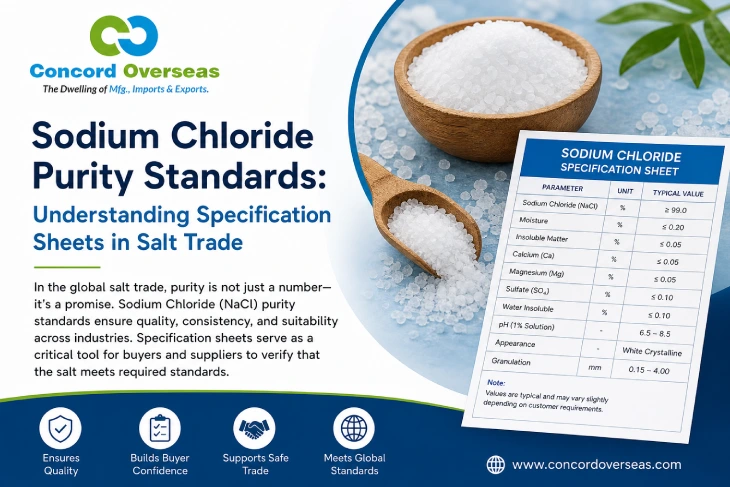
A typical spec sheet for refined salt lists sodium chloride content by percentage, moisture levels, insoluble matter, and the presence of specific minerals like calcium, magnesium, and sulfate. For iodized salt, it also states the iodine content, usually expressed in parts per million of potassium iodate.
Buyers new to the trade sometimes assume a higher NaCl percentage automatically means better salt. That is only partly true. A 99.9% NaCl assay sounds impressive, but if the moisture content is high or the granule size is inconsistent, the product will clump in transit and perform poorly in packaging lines.
Color and granule uniformity also appear on most spec sheets, even though they rarely get discussed in buyer conversations. A batch with visible color variation often signals inconsistent sourcing or blending, which can affect downstream taste and appearance in finished food products.
Numbers on paper only mean so much without context. A spec sheet showing 98.5% NaCl from one region might represent excellent quality, while the same number from a different source could indicate a problem, depending on the mineral profile of the raw material.
This is why buyers working with an established triple refined free flow iodized salt supplier tend to ask for batch-specific lab reports rather than relying on a generic product brochure. Generic sheets describe what the product is supposed to be; batch reports describe what actually shipped.
Iodine is volatile. It degrades with exposure to moisture, heat, and light, which means the iodine level stated at the time of packing is not always the iodine level present when the product reaches a shelf six months later.
Regulatory bodies in different countries set their own thresholds for iodine fortification, and these thresholds are not interchangeable. A level that satisfies food safety authorities in one country might fall short of requirements in another, so buyers sourcing for multiple markets need to confirm country-specific compliance rather than assuming one certificate covers everything.
Stabilization matters here. Salt that has been properly dried and packed in moisture-resistant bags retains iodine far longer than salt exposed to humid storage conditions. This is a packaging and logistics issue as much as a chemistry one, and it rarely gets the attention it deserves during sourcing calls.
Free flow properties are not separate from purity discussions, even though they often get treated as a packaging afterthought. Anti-caking agents like sodium ferrocyanide or magnesium carbonate are added in small, regulated amounts, and their presence should be disclosed on the spec sheet.
Buyers should know exactly which anti-caking agent is used, at what concentration, and whether it is approved for food use in the destination market. Some countries restrict or ban certain anti-caking compounds entirely, which makes this a compliance issue, not a cosmetic one.
A triple refined free flow iodized salt exporter that documents this clearly on paper is signaling something useful: a willingness to be checked. That transparency is worth more than marketing language about quality.
Granule size distribution deserves a mention here too, since it ties directly into how well an anti-caking agent performs. Salt with a wide range of particle sizes in one bag tends to separate during transport, with finer particles settling at the bottom and clumping more readily, regardless of how much anti-caking treatment was applied during processing.
Side-by-side comparison only works when buyers are comparing equivalent testing methods. One supplier might test moisture content using a gravimetric method, while another uses a different standard entirely, and the resulting numbers are not directly comparable without knowing the method behind them.
Asking for the testing methodology, not just the result, separates serious sourcing conversations from surface-level ones. Reputable manufacturers will name the method, often referencing AOAC or ISO testing protocols, and most will share this without hesitation if asked directly.
Price differences between suppliers often trace back to processing depth rather than raw material cost. Triple refining removes more impurities than single or double refining, which adds a processing step and, with it, a marginal cost increase that shows up in the final quote.
A spec sheet with rounded, suspiciously clean numbers across every parameter is worth a second look. Real lab results carry small variations between batches; a sheet showing identical figures across multiple shipment dates suggests the document was copied rather than tested.
Missing batch numbers or test dates are another warning sign. A specification sheet without traceability to an actual production run is closer to a sales brochure than a quality document, regardless of how detailed it looks.
Vague language around iodine stability, such as claims of "long shelf life" without supporting data, should prompt a direct question rather than acceptance at face value.
Contracts built around clear specification language protect both sides. A buyer who specifies exact tolerances for NaCl percentage, moisture, and iodine content has a much stronger position if a dispute arises later, compared to one who relied on a verbal assurance of "good quality salt."
Tolerance ranges matter more than single-point targets. Natural variation between harvests and processing runs means a spec sheet stating "minimum 98% NaCl" gives a supplier room to meet expectations consistently, while a sheet demanding an exact, unrealistic figure sets up friction before the first shipment even ships.
Third-party inspection at the port of loading adds a layer of verification that many experienced importers now treat as standard practice rather than an optional extra. The cost is modest compared to the expense of a rejected container.
Packaging tolerances belong in the same conversation as chemical specifications, even though buyers often separate the two. A contract that fixes bag weight at exactly 25 kilograms with zero allowable variance creates unnecessary friction, since minor weight fluctuation during automated filling is normal and expected across the industry.
Buyers who treat specification sheets as a starting point for conversation, rather than a final checklist, tend to build stronger supplier relationships over time. Questions about testing frequency, storage conditions, and traceability open a dialogue that a one-time price negotiation never does.
A supplier confident in its process will welcome these questions. Hesitation or vague answers around basic quality documentation is itself useful information, often more telling than the numbers on the page.
ISO 14001 and HACCP certifications speak to process control and environmental management rather than guaranteeing a specific purity figure, and the distinction matters. These certifications confirm that a facility follows documented procedures consistently, which supports purity claims without replacing the need for batch-level testing.
Buyers sometimes treat certification logos as a substitute for asking detailed questions. Certification narrows the field of trustworthy suppliers, but it does not eliminate the need to review actual test results for the specific batch being purchased.
Export experience adds another layer of confidence. A manufacturer with over a decade of shipping history across multiple countries has likely encountered and resolved the customs and compliance issues that a newer exporter has not yet faced.
Specification sheets reward buyers who read them slowly and ask questions about anything unclear, rather than treating them as paperwork to file away. The next time a quote arrives with an attached spec sheet, set aside ten minutes to check testing methods, batch traceability, and anti-caking disclosure before moving to price discussions.
That habit, repeated across every order, separates buyers who get occasional shipment surprises from those who do not. The document itself is simple; the discipline to question it properly is what actually protects a sourcing relationship.
For anyone currently comparing suppliers, requesting three recent batch reports alongside the standard spec sheet offers a far clearer picture than a single brochure ever will. That small request, made before signing anything, tends to save far more time than it costs.